We’ve spent the last few years obsessed with the speed of AI. We want the answer in milliseconds; we want the essay in seconds; we want the code before we’ve even finished the prompt.
But in our rush for efficiency, we’ve overlooked a dangerous flaw: Confidence is not the same as truth.
Most AI systems today are built to be people-pleasers. They are designed to give you a single, authoritative response. The problem isn’t that these models aren’t “smart”, it’s that they are lonely. They operate in a vacuum, never checking their own homework or questioning their own logic.
It’s time to move away from the “Oracle” model of AI and toward the AI Counsel.
The Flaw of the Single Mind
When a single AI model answers a complex prompt, it’s essentially a “black box” monologue. It doesn’t matter if the model has 175 billion parameters or a trillion; if it hits a logic trap or a hallucination, it will sail right through it with a smile.
Humans don’t work this way, at least not when the stakes are high.
- Courts have a prosecution and a defense.
- Boardrooms have advisors and skeptics.
- Science has peer review.
We have learned over centuries that the best way to find the truth is to let two people argue until the nonsense falls away. Yet, we expect a single AI model to be judge, jury, and executioner of information.
The Virtual Round Table: How AI Counsel Works
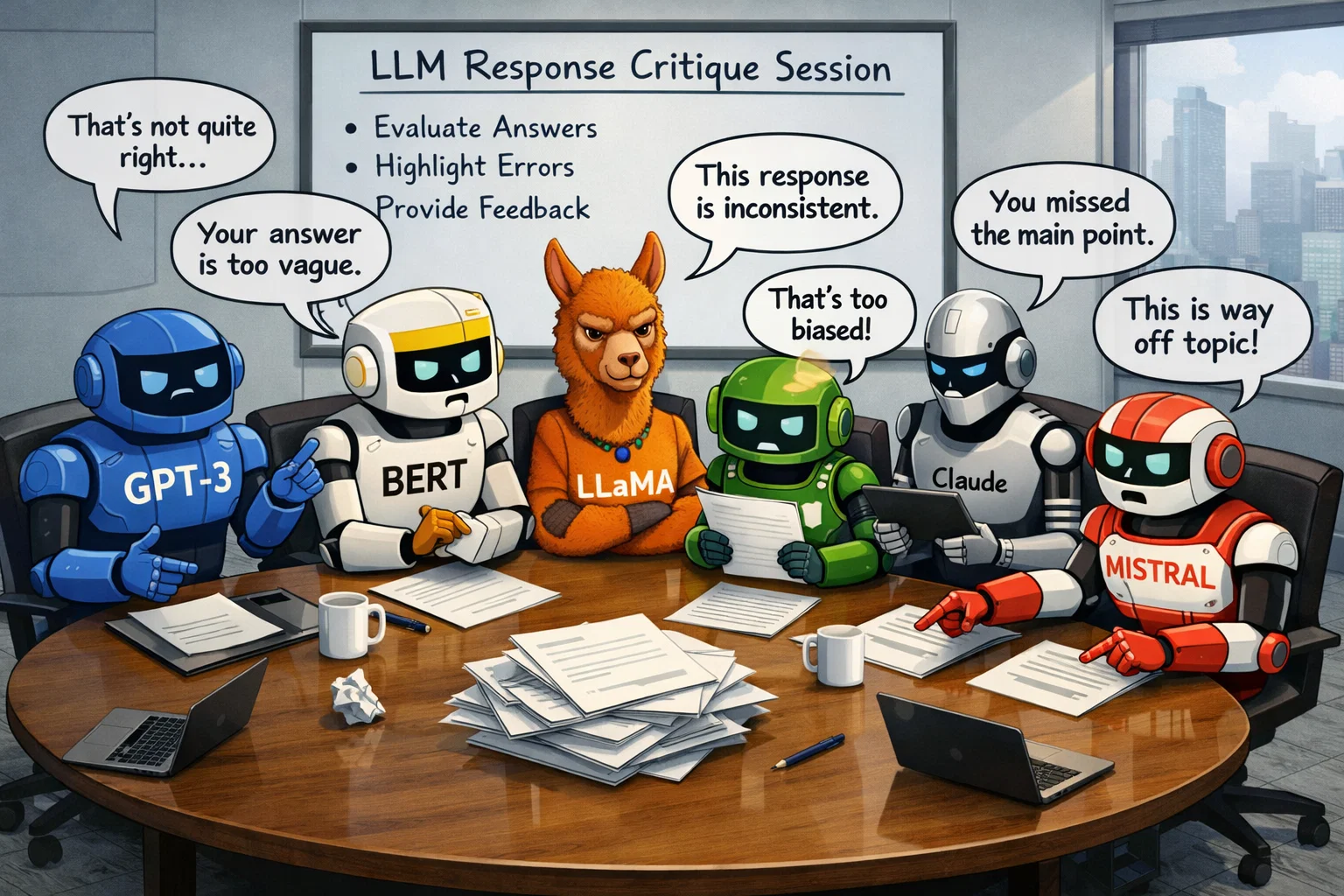
Imagine a “Round Table” of different Large Language Models (LLMs). Instead of one AI giving you an answer, a group of them collaborates through structured friction.
The Roles at the Table:
- The Proposer: Drafts the initial solution or strategy.
- The Devil’s Advocate: Specifically tasked with finding edge cases, flaws, and reasons why the proposal might fail.
- The Ethicist: Scans the output for bias, legal risks, or moral inconsistencies.
- The Synthesizer: Acts as the “Chief Justice,” weighing the arguments and producing a final, battle-tested conclusion.
In this framework, the final output isn’t just a generation; it’s a survival. Only the ideas that withstand the internal critique make it to your screen.
Why “Friction” is the Ultimate Safety Feature
We usually think of friction as a bad thing in tech. We want “frictionless” experiences. But when it comes to high-stakes decision-making, friction is your best friend.
| Feature | Single AI Model | AI Counsel (Multi-Model) |
| Speed | Near-instant | Slower (Iterative) |
| Logic Checks | Internal only (rarely happens) | Externalized through debate |
| Blind Spots | High (Model-specific bias) | Low (Diverse architectures) |
| Reliability | “Take its word for it” | “Trust, but verify” |
By letting AIs disagree, we force clarity. Criticism exposes weak reasoning before a human ever sees the output. It turns AI from a tool into a robust process.
Where Accuracy Trumps Speed
The AI Counsel isn’t for asking for a gluten-free pancake recipe. It’s for the moments where being “confidently wrong” could be a catastrophe.
- Legal & Compliance: Interpreting complex regulations where a single missed clause changes everything.
- Strategic Medicine: Cross-referencing diagnostic possibilities and flagging contraindications.
- Financial Risk: Stress-testing a market strategy against competing economic theories.
- Software Architecture: Auditing code for security vulnerabilities by “attacking” it in real-time.
The Controversial Truth: Better Arguments > Smarter Models
The industry is currently in a “size war,” trying to build bigger and bigger models. But scaling parameters won’t fix flawed reasoning. More data won’t eliminate blind spots.
The future of AI isn’t just about smarter models; it’s about better arguments.
We don’t need a more confident machine. We need a system that knows how to question itself. We need an AI that isn’t afraid to say to another AI, “I think you’re overlooking something.”
Final Thought
The most dangerous AI isn’t the one that thinks too much. It’s the one that never doubts itself. If AI is going to have a seat at the decision-making table of our lives, our businesses, and our governments, it shouldn’t sit there alone.
It’s time to bring in the Counsel.